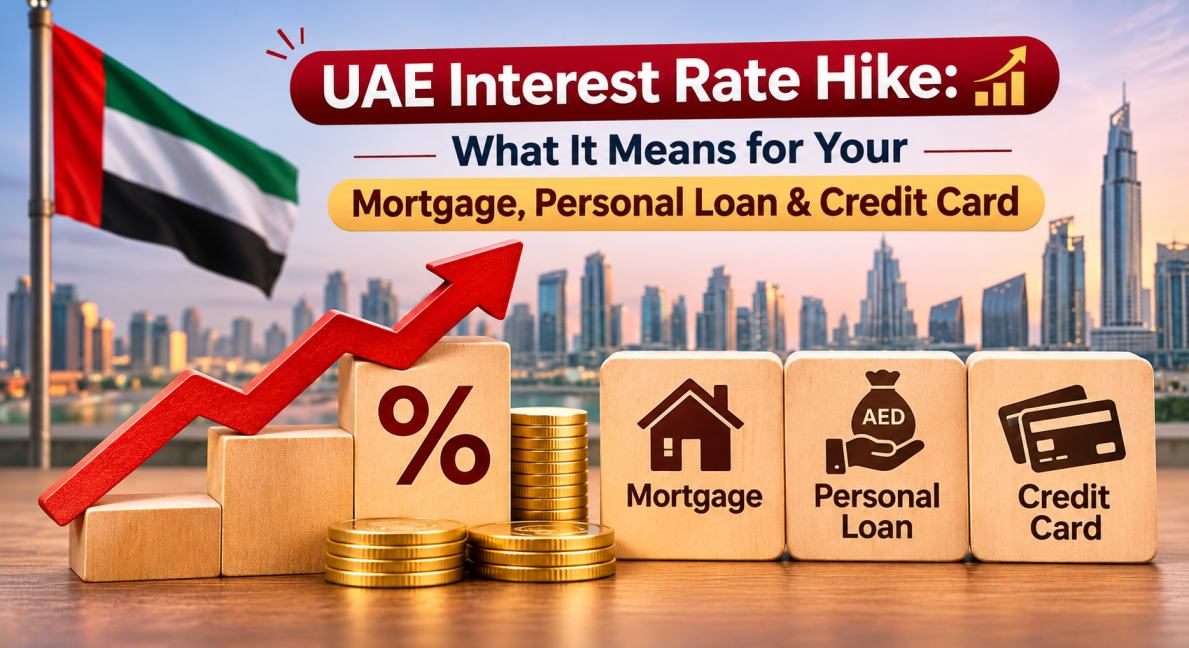
The UAE interest rate hike in September 2026 pushed local borrowing costs up for the first time since 2023, and many residents are asking one thing: will my monthly payments go up? For most people the change is modest, but the impact depends on the type of loan you hold, how it is priced and when it next resets. This guide explains what happened, how each product is affected and what you can do now.
Key takeaways
- The Central Bank of the UAE raised its Base Rate from 3.65% to 3.9% on 17 September 2026 and held it there on 28 October.
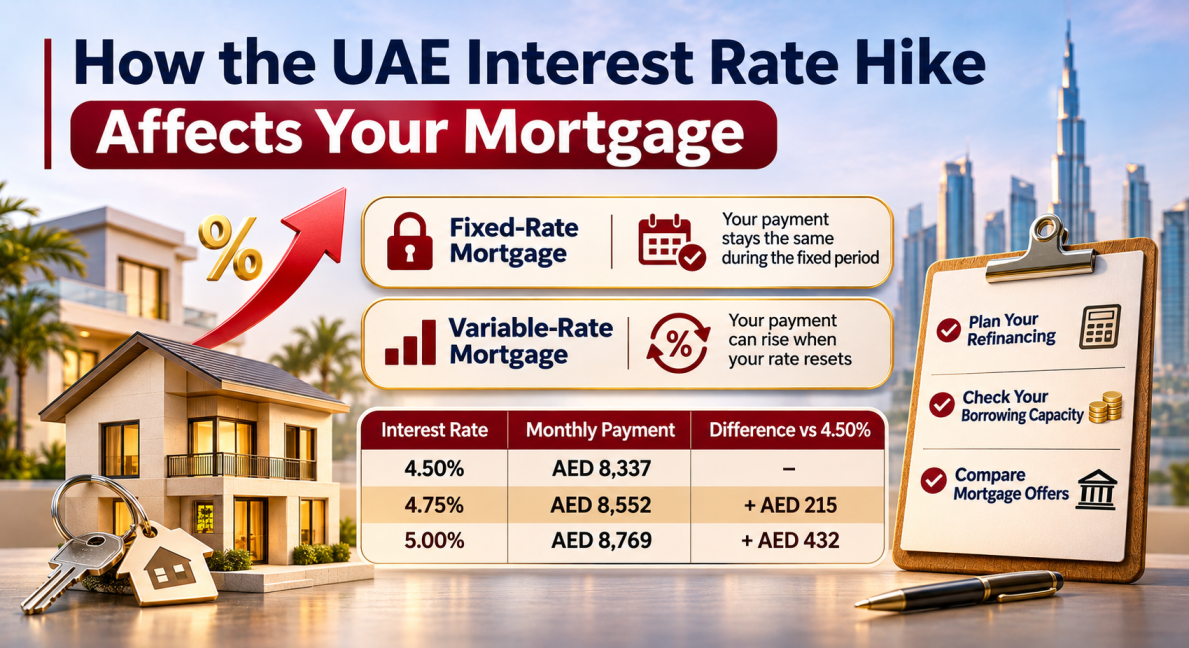
- Fixed-rate mortgage payments stay the same until the fixed period ends. Variable-rate payments can rise at the next reset.
- Existing personal loans are usually fixed-rate, so instalments rarely change, but approval and borrowing limits can tighten.
- Credit card rates are unlikely to move much. Carrying a balance is still the expensive part.
What Happened in the UAE Interest Rate Hike?
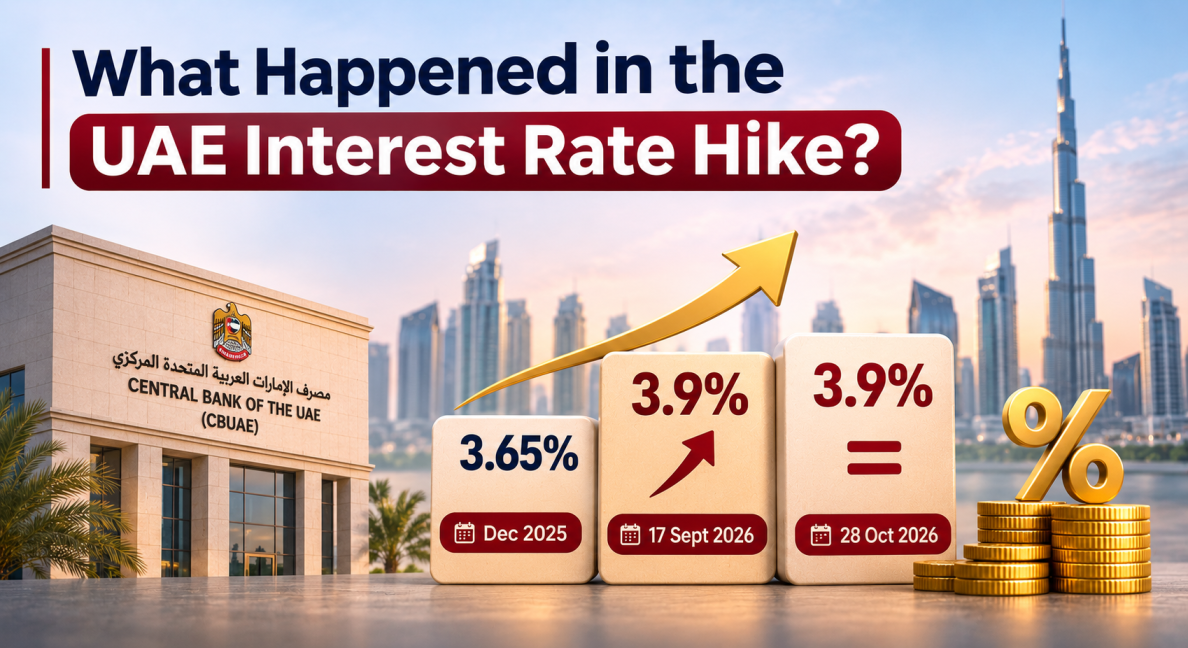
On 16 September 2026, the US Federal Reserve raised its Interest Rate on Reserve Balances by 25 basis points, its first increase since 2023. The Central Bank of the UAE (CBUAE) followed the next day, lifting its Base Rate from 3.65% to 3.9%, effective 17 September.
On 28 October, the Fed held its rate at 3.75% to 4.00%, and the CBUAE kept the Base Rate at 3.9%. That is still well below the 5.40% level of 2023 and early 2024. The move also reverses part of the easing seen in 2025, when the CBUAE cut its Base Rate by 75 basis points in total, and it suggests the run of falling borrowing costs has paused for now.
| Date | What happened | UAE Base Rate |
| December 2025 | Third 25-basis-point cut of 2025 | 3.65% |
| 17 September 2026 | Raised by 25 basis points after the Fed hike | 3.9% |
| 28 October 2026 | Held after the Fed decision | 3.9% |
Why the UAE Follows the US Fed, and Where EIBOR Fits In
The dirham is pegged to the US dollar, so the CBUAE anchors its Base Rate to the Fed’s rate. The Base Rate sets the floor for overnight borrowing between banks.
Your own loan is priced differently. Banks add their margin to a benchmark called EIBOR (the Emirates Interbank Offered Rate), which reflects what UAE banks charge each other. Many variable mortgages are linked to 3-month EIBOR, but check your contract. When the Base Rate moves, EIBOR tends to follow. These were the CBUAE fixings on 19 October 2026:
| EIBOR term | Rate |
| 1 month | 4.10% |
| 3 months | 4.21% |
| 6 months | 4.45% |
| 12 months | 4.93% |
How the UAE Interest Rate Hike Affects Your Mortgage
Mortgages feel a rate change the most because the loans are large and long. If you are planning a purchase, our home loan in UAE page explains your financing options.
Fixed-rate mortgages
Most UAE home loans are fixed for one to five years and then switch to EIBOR plus a bank margin. Your payment does not change during the fixed period. What matters is the date it ends. If that is within the next 6 to 12 months, start comparing refinancing options now. Many borrowers use that date as a prompt to compare offers from other banks.
Variable-rate mortgages
Your payment can rise when your rate next resets, and the timing depends on your bank and contract. Here is what a small move means on a AED 1,500,000 mortgage over 25 years. These are example calculations, not bank quotes.
| Interest rate | Monthly payment | Difference vs 4.50% |
| 4.50% | AED 8,337 | – |
| 4.75% | AED 8,552 | +AED 215 |
| 5.00% | AED 8,769 | +AED 432 |
A 0.25% rise adds roughly AED 215 a month on this loan. You can test your own numbers with our mortgage calculator. If you are unsure which structure suits you, read our guide to fixed vs variable rate mortgages.
If you are buying now: rates and borrowing capacity
In mid-September, lenders were quoting fixed three-year rates of about 3.89% to 4.24%, so pricing has been fairly flat. The bigger effect may be on how much you can borrow. Mortgage advisers at Lomond say the more immediate impact is on borrowing capacity rather than the rate itself.
Banks test your monthly debt payments against your income. If your budget allows a payment of AED 8,337, the loan you can afford falls from AED 1.5 million at 4.50% to about AED 1.46 million at 4.75%. Your income has not changed, but your borrowing limit has.
What the UAE Interest Rate Hike Means for Personal Loans
Most personal loans in the UAE are fixed or flat-rate, so if you already have one, your instalment is unlikely to change after the UAE interest rate hike. For a new loan, your profile matters more than a quarter-point move. Banks look at your salary, employer, existing debt and your credit report from Al Etihad Credit Bureau (AECB).
Lenders have also stayed careful. Bank representatives told The National that unsecured products remain relatively hard to get. To strengthen your application, explore our personal loan in UAE options, check your eligibility for a personal loan, and learn how to improve your UAE credit score. If your salary is on the lower side, see our guide to a personal loan on a AED 2,000 salary.
Will Credit Card Interest Rates Go Up?
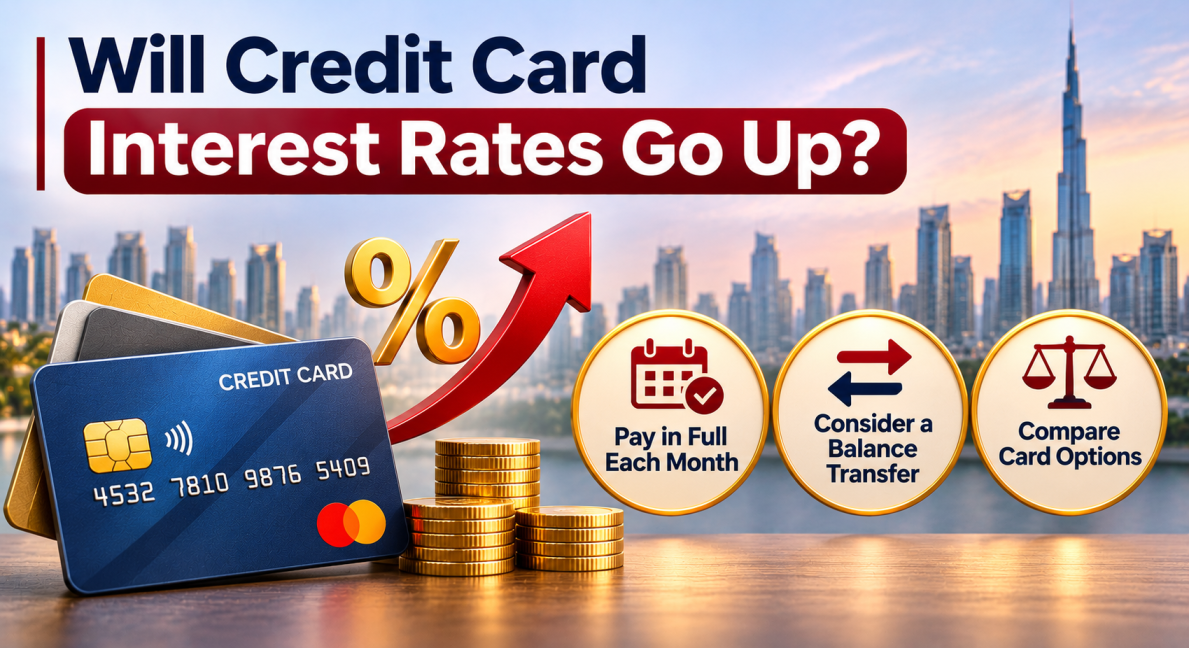
The UAE interest rate hike is unlikely to change your card’s rate overnight. Credit card rates are already considerably higher than money-market rates, so a quarter-point move makes little difference.
The real cost is carrying a balance. Paying in full each month avoids interest altogether. If you hold a balance, check whether a balance transfer or a lower-cost loan makes sense, and compare fees and the rate after any promotional period. You can also browse credit cards in the UAE to compare options.
Car Loans and Business Loans
Car loans are typically fixed-rate, so your current instalment should stay the same. Check your contract if you are unsure. Business borrowers face more exposure. Companies and SMEs with EIBOR-linked facilities will pay more interest as EIBOR moves, and banks have tightened criteria for new SME borrowers. If you run a business, see our business loan in UAE page, and compare structures before committing.
What About Savers?
Higher rates generally lift deposit returns, so savers may benefit. Banks do not always pass increases on quickly, so compare fixed deposit and savings rates rather than assuming yours will rise.
Will UAE Interest Rates Come Down?
There is no clear consensus. The Fed held in October after its September increase, and some analysts expect UAE borrowing costs to stay elevated for some time. Even if rates fall, mortgage advisers say UAE mortgage pricing may move only modestly. Waiting also carries its own risk, because property prices, your salary and lending criteria can change in the meantime. A 0.25% cut would save roughly AED 215 a month on the AED 1.5 million example above, which is helpful but not life-changing. Rather than waiting for a cut, focus on your profile and loan structure, and review refinancing if rates ease later.
What to Do After the UAE Interest Rate Hike
- Check your loan type. Find out whether your mortgage is fixed or variable, and note when the fixed period ends or the rate resets.
- Stress-test your budget. Calculate your payment at 0.5% to 1% above your current rate and make sure it still works.
- Know your borrowing limit. If you plan to buy, get a pre-approval so you know what you can afford at today’s rates.
- Compare several banks. Rates vary by salary, employer, loan size and whether you transfer your salary. A mortgage consultant in Dubai can compare offers for you.
- Pay down expensive debt first. Credit card balances cost far more than a mortgage.
- Avoid unnecessary applications. Multiple applications can show on your credit report, so apply to a short list of suitable lenders.
- Plan refinancing early. If your fixed period ends soon, start comparing options several months ahead.
Get Expert Help With Your Next Step
Whether you want to lock in a fixed rate, review your current mortgage or find the right loan after the UAE interest rate hike, the Loan Market team can compare offers across UAE banks. Explore our home loan, personal loan and business loan services, or contact us for personalised advice.
Frequently Asked Questions
Q1. Did UAE interest rates go up in 2026?
Yes. The CBUAE raised its Base Rate by 25 basis points to 3.9% on 17 September 2026, following the Fed’s increase. It held the rate at 3.9% on 28 October.
Q2. What is the current UAE Base Rate?
The Base Rate is 3.9% as of the CBUAE’s 28 October 2026 decision. Check the Central Bank website for any later changes.
Q3. Will my fixed-rate mortgage payment go up after the UAE interest rate hike?
Not during the fixed period. Your payment can change once the fixed period ends and the loan moves to a variable rate.
Q4. Will my variable-rate mortgage payment increase?
It can. Variable rates follow EIBOR plus your bank’s margin, and your payment changes when your rate next resets. Check your contract for the reset date.
Q5. Will UAE mortgage rates increase for new buyers?
Advisers expect only modest changes to standard fixed-rate products. The bigger effect may be a lower borrowing limit. Your own rate depends on your profile.
Q6. Can a bank increase the interest rate on my existing personal loan?
Most UAE personal loans are fixed or flat-rate, so the rate is set in your contract and usually does not change. Check your loan agreement to confirm.
Q7. Will credit card interest rates increase in the UAE?
Unlikely in a significant way. Card rates are already well above money-market rates. Paying your balance in full is the best way to avoid interest.
Q8. How does the rate hike affect how much I can borrow?
Higher rates raise the monthly payment on a given loan, so banks may approve a lower amount for the same income. Pre-approval shows your limit at current rates.
Q9. Should I switch from a variable to a fixed-rate mortgage now?
It depends on how much payment certainty you need and any early settlement costs. Compare the total cost with an adviser before switching.
Q10. When will UAE interest rates come down?
Nobody knows. UAE rates follow the Fed because of the peg, and the Fed has held since its September increase. Review your options if rates fall.