Key Takeaways
- A salary transfer loan in UAE is a personal loan where your monthly salary is credited directly into an account with the lending bank.
- It usually comes with lower interest rates and higher borrowing limits than a non-salary-transfer loan.
- Minimum salary requirements typically start around AED 5,000, though this varies by bank and by whether you’re a UAE National or an expat.
- You can still get a loan without transferring your salary — but usually at a higher interest rate.
- A loan broker can help you compare offers across banks so you don’t end up locked into the first (or most expensive) option.
If you’ve ever applied for a personal loan in the UAE, you’ve probably come across the term “salary transfer” somewhere in the fine print. It sounds like a small detail, but it actually changes how much you pay, how fast you get approved, and how much you can borrow. This guide breaks down exactly what a salary transfer loan is, who qualifies, and how to decide if it’s the right route for you.
What Is a Salary Transfer Loan in UAE?
A salary transfer loan in UAE is a personal loan that requires you to have your monthly salary credited directly into an account held with the same bank that’s giving you the loan. In simple terms, the bank wants to see your paycheck landing in their system every month, because that gives them confidence you’ll repay on time.
This isn’t some obscure product — it’s actually the most common type of personal loan structure in the country. Most UAE residents get paid through the Wages Protection System (WPS), a government-mandated electronic payroll system that ensures salaries are paid on time and through approved channels. When you take a salary transfer personal loan UAE banks offer, you’re essentially routing that same WPS salary into the lender’s account instead of a separate bank.
Because the bank has direct visibility into your income, it treats you as a lower-risk borrower. That’s why salary transfer loans almost always come with better interest rates than the alternative.
How Does a Salary Transfer Loan Work?
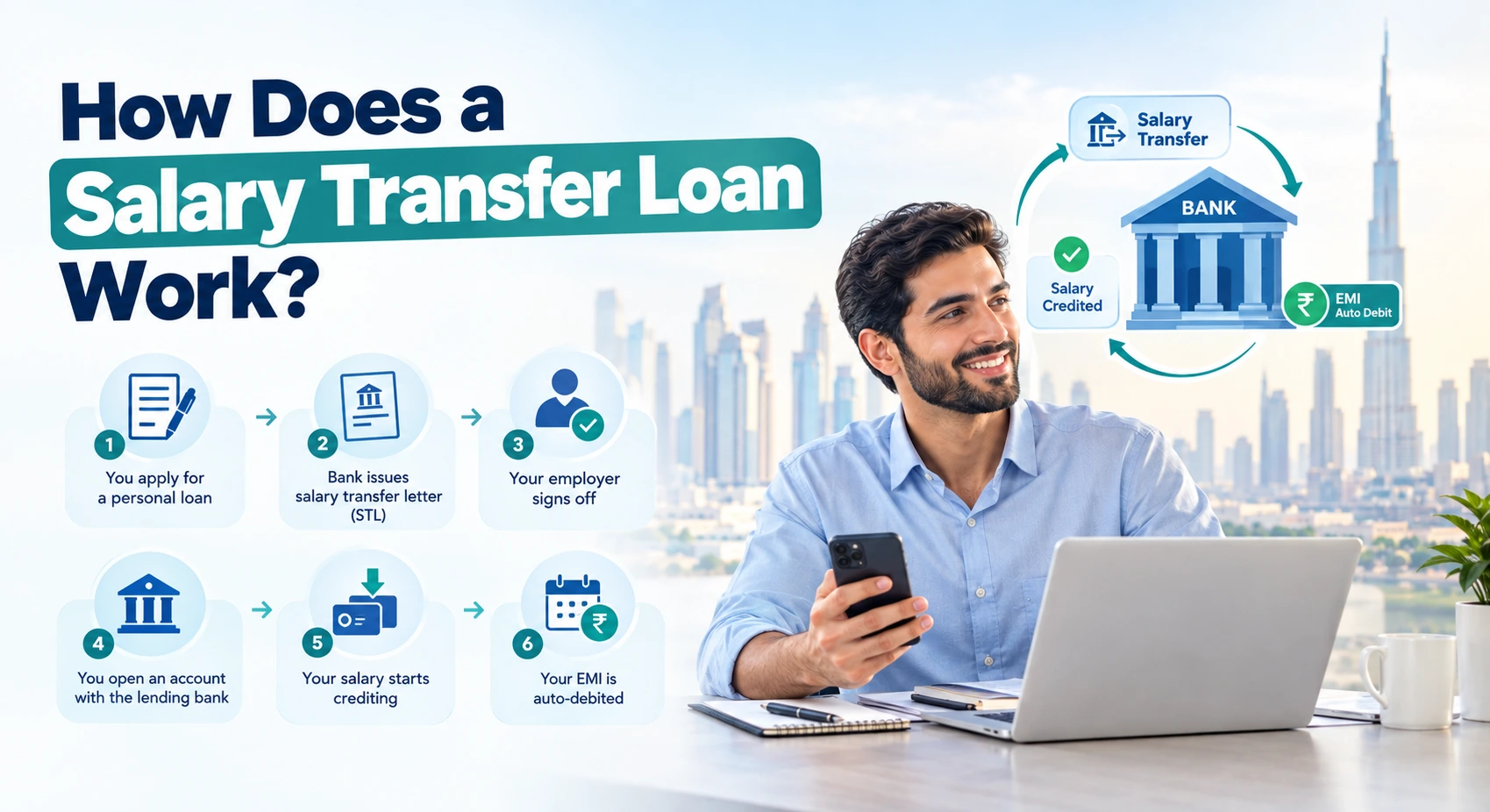
The process is more straightforward than most people expect. Here’s how it typically plays out:
- You apply for a personal loan in UAE with a bank that offers a salary transfer facility.
- The bank issues a salary transfer letter (STL) — a formal document confirming that your salary will be redirected to your new account with them.
- Your employer signs off on the letter, confirming your employment, salary, and the transfer arrangement.
- You open an account with the lending bank, if you don’t already have one.
- Your salary starts crediting into this new account from your next pay cycle onward, through the Wages Protection System (WPS).
- Your EMI is auto-debited from the same account every month, right after your salary lands — so repayment happens automatically with no manual transfers needed.
Before any of this is finalised, the bank will also check your AECB credit score, along with your employer’s standing and your salary history, to decide how much you can borrow and at what rate. A strong score generally means faster approval and better terms, so it’s worth knowing where you stand before you apply.
One thing worth understanding upfront: once you commit to a salary transfer loan UAE banks issue this way, you generally can’t move your salary elsewhere until the loan is fully repaid, unless you settle the outstanding balance first. It’s a commitment, not just a formality.
Who Is Eligible for a Salary Transfer Loan?
Eligibility criteria differ slightly depending on whether you’re a UAE National or an expat, though both groups follow the same basic principle: a stable, verifiable salary.
For UAE Nationals
- Age typically between 21 and 65
- Minimum monthly salary of around AED 5,000 (varies by bank)
- Minimum employment period, often as little as 3 months
- Valid Emirates ID
- Good standing with the Al Etihad Credit Bureau (AECB)
For Expats
- Age typically between 21 and 60
- Minimum monthly salary usually AED 5,000–8,000, depending on the bank
- Employer must often be on the bank’s approved company list
- Minimum service period with current employer (commonly 3–6 months)
- Valid passport, UAE residence visa, and Emirates ID
If your salary transfer relationship is strong and consistent, it doesn’t just help with loans — it can also make you eligible for a pre-approved credit card in UAE with better terms, since the bank already has visibility into your income. And down the line, that same track record can strengthen your home loan eligibility if you’re planning to buy property later.
Self-employed individuals generally don’t qualify for standard salary transfer loans, since there’s no employer or WPS salary to transfer. If that’s your situation, a business loan in UAE built around your business income is usually a better fit.
Documents Required
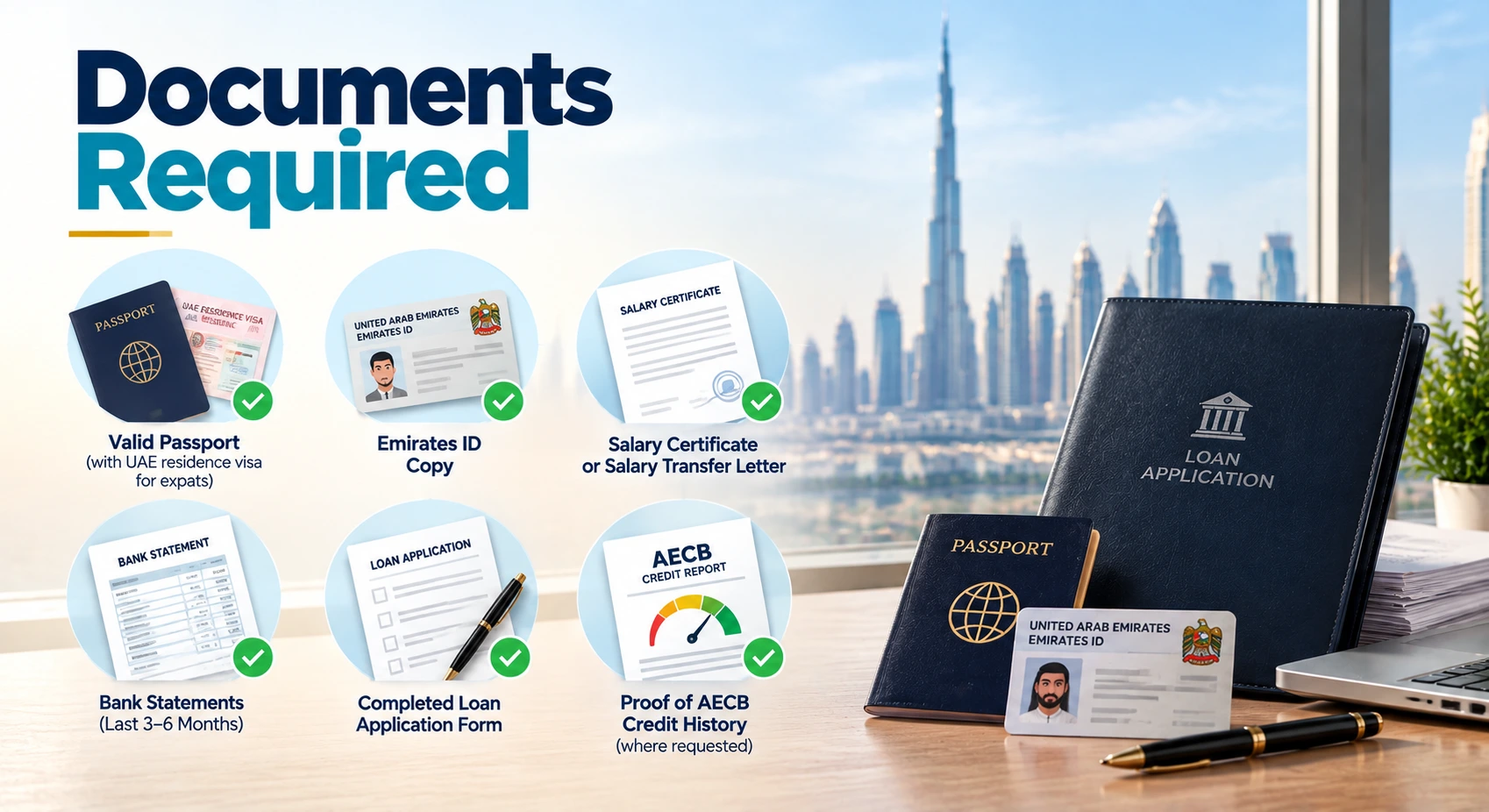
Requirements can vary slightly bank to bank, but you’ll typically need:
- Valid passport (with UAE residence visa for expats)
- Emirates ID copy
- Salary certificate or salary transfer letter from your employer
- Bank statements for the last 3–6 months
- Completed loan application form
- Proof of AECB credit history, where requested
Having these ready before you apply speeds up approval significantly — most delays happen because of missing or outdated documentation, not credit issues.
Salary Transfer vs. Non-Salary Transfer Loan
Here’s a side-by-side look at how the two options compare:
| Feature | Salary Transfer Loan | Non-Salary Transfer Loan |
| Interest rate | Lower (often single digits) | Higher (can reach mid-to-high teens) |
| Loan amount | Higher (up to 20x salary, in some cases) | Generally lower |
| Approval speed | Faster, due to direct income verification | Slower, more scrutiny required |
| Flexibility | Salary locked with lender bank | Salary account stays wherever you like |
| Best suited for | Long-term employees with stable jobs | Those who don’t want to switch banks |
There’s no universally “better” option here — it depends on whether the lower rate is worth giving up flexibility over where your salary sits.
Can You Get a Loan Without Salary Transfer in UAE?
Yes. A personal loan without salary transfer UAE banks offer does exist, and it’s a reasonable option if you don’t want to move your salary account, or if you have multiple income sources you’d rather keep separate. The trade-off is straightforward: interest rates on non-salary-transfer loans are typically higher, sometimes by several percentage points, since the bank takes on more risk without direct income visibility.
Several major UAE banks offer this option, generally requiring a higher minimum salary (often AED 15,000 or more) to offset that added risk. If keeping your banking relationships as they are matters more to you than shaving points off your interest rate, this route is worth exploring.
Pros and Cons of Salary Transfer Loans
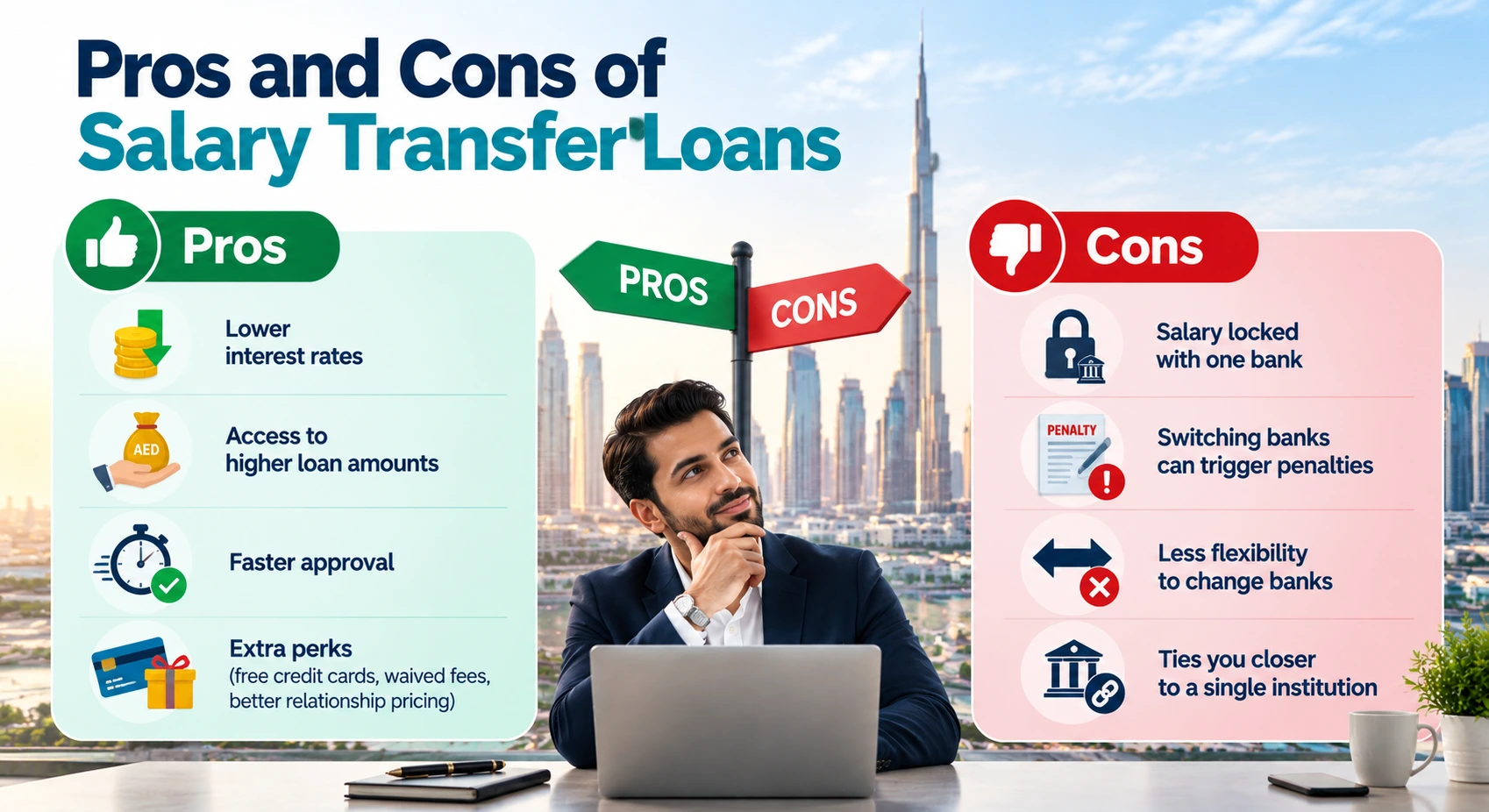
Pros:
- Lower interest rates compared to non-salary-transfer options
- Access to higher loan amounts
- Faster approval, since income is verified directly
- Can lead to added perks — free credit cards, waived account fees, better relationship pricing
Cons:
- Your salary is locked with one bank for the loan tenure
- Switching banks mid-loan can trigger penalties or require full settlement
- Less flexibility if you want to change banking relationships
- Ties your financial life more closely to a single institution
How a Loan Broker Helps You Get a Better Deal
Here’s something most guides on this topic miss: not every bank treats salary transfer loans the same way. Interest rates, eligibility thresholds, and processing times can vary quite a bit from one bank to the next — even for applicants with near-identical salaries and credit profiles. What looks like a good deal from one bank might not even be the best option available to you.
This is where working with a loan consultant makes a real difference. At Loan Market, we compare offers across our banking network on your behalf — including salary transfer and non-salary-transfer options — so you’re not stuck with whatever the first bank quotes you. If a salary transfer loan makes sense for your situation, we help you find the bank offering the best rate for your profile. If it doesn’t, we’ll point you toward non-salary-transfer alternatives or other financing routes that fit better.
FAQs

Q1. What is a salary transfer loan in UAE?
A salary transfer loan is a personal loan where your monthly salary is credited directly into an account with the bank providing the loan. This gives the bank direct visibility into your income, which typically results in lower interest rates and faster approval.
Q2. Is salary transfer mandatory to get a personal loan in UAE?
No, salary transfer is not mandatory. Most UAE banks also offer personal loans without salary transfer, though these usually come with higher interest rates and stricter minimum salary requirements.
Q3. What is the minimum salary required for a salary transfer loan in UAE?
Minimum salary requirements typically range from AED 5,000 to AED 8,000, depending on the bank. UAE Nationals sometimes qualify with slightly lower thresholds than expats.
Q4. Can expats apply for a salary transfer loan in UAE?
Yes, expats can apply for a salary transfer loan as long as they meet the bank’s minimum salary, employment duration, and visa requirements. Some banks also require the employer to be on their approved company list.
Q5. How much loan amount can I get with a salary transfer loan?
Loan amounts vary by bank and salary, but many lenders offer up to 20 times your monthly salary, with some UAE National products going as high as AED 5 million.
Q6. Can I switch my salary to another bank after taking a salary transfer loan?
Generally, no — not without settling the existing loan first. Moving your salary elsewhere while the loan is still active usually breaches the loan terms and can trigger penalties or require full repayment.
Q7. What documents are needed for a salary transfer loan in UAE?
You’ll typically need a valid passport, Emirates ID, salary certificate or salary transfer letter from your employer, and 3–6 months of bank statements. Some banks may also request your AECB credit report.
Q8. Does a good AECB credit score help with a salary transfer loan?
Yes, a strong AECB credit score can speed up approval and improve the interest rate you’re offered, since it signals lower repayment risk to the bank.
Q9. What’s the difference between a salary transfer loan and a non-salary transfer loan?
A salary transfer loan usually offers lower interest rates and higher loan amounts because the bank verifies your income directly. A non-salary transfer loan lets you keep your existing salary account but typically comes with higher interest rates and lower borrowing limits.
Q10. Can self-employed individuals get a salary transfer loan in UAE?
No, salary transfer loans are designed for salaried employees with a verifiable employer and WPS salary. Self-employed individuals are usually better suited to a business loan based on their business income and bank statements instead.
Ready to Compare Your Options?
Whether you’re eligible for a salary transfer loan or need a non-salary-transfer alternative, the terms you get can vary a lot depending on which bank you approach. Talk to Loan Market today, and we’ll compare offers across our network to find the loan that actually fits your salary, your job, and your goals.